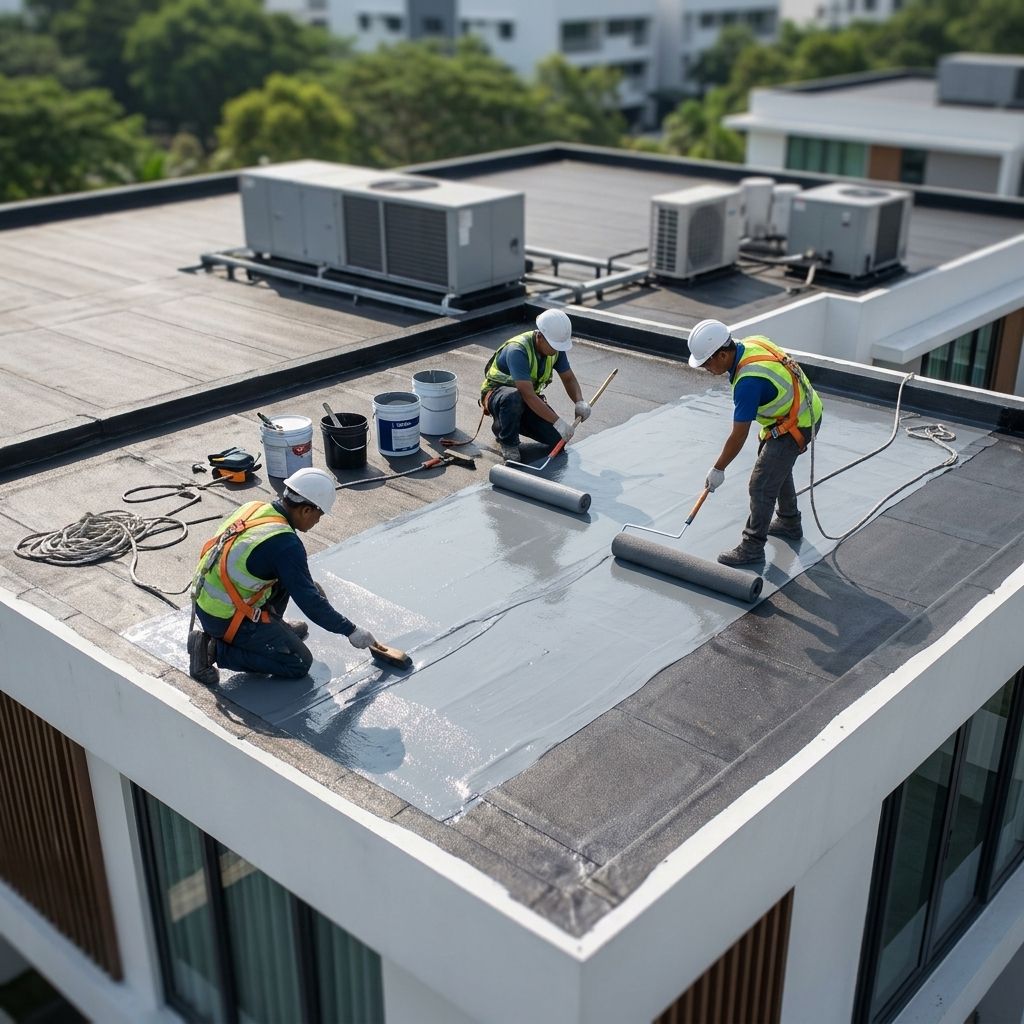
A flat roof in Klang Valley, Johor Bahru, or Penang rarely fails from one big storm — it fails from months of ponding water finding the weakest seam. This guide walks through the diagnosis-first approach that actually stops water leakage from a flat roof, not just the patch that hides it for one monsoon season.
- Trace the leak to ponding areas, flashing, or membrane seams before choosing any fix — guessing wastes money.
- Correcting slope and applying an elastomeric coating system is how to stop water leakage from flat roof structures long-term.
- Ponding water sitting past 48 hours signals a drainage fault, not a coating fault.
- DIY sealant buys weeks; a proper waterproofing membrane from Wai Hong Brothers is built to outlast several monsoon seasons.
Why This Leak Keeps Coming Back
Flat and low-slope roofs in Malaysia sit under intense UV exposure by day and heavy monsoon rainfall by night, which stresses membranes far faster than pitched tile roofs. Most call-outs Wai Hong Brothers handles across Klang Valley and Johor Bahru in 2026 trace back to the same root cause: water sitting still instead of running off.
Building standards call for a minimum slope of 1/4 inch per foot (roughly 2%) on flat roof surfaces so rainwater drains within 24 to 48 hours. When that slope has settled, been built too shallow, or a drain has silted up, water pools — and pooled water finds every hairline crack in a membrane within one or two seasons. Treating the symptom with sealant while ignoring the slope means the same leak returns after the next heavy rain.
That's why an accurate repair starts with a site inspection, not a tube of sealant.
What You'll Need
- A dry, sunny day with no rain forecast for at least 24 hours
- A stiff broom and a garden hose (for leak-tracing, not repair)
- Moisture meter or simple visual check for dark, spongy patches on the ceiling below
- Flashlight for inspecting flashing, drains, and roof penetrations
- Elastomeric or acrylic waterproofing coating rated for flat roof membranes, if attempting a temporary patch
- Access to the roof — ladder, harness, and someone on the ground for safety
- For anything beyond a small localized patch, a licensed contractor such as Wai Hong Brothers to run a proper diagnostic and quote a membrane system
If the leak is active or the ceiling stain is spreading, skip the DIY step and get a site inspection first — walking a wet, compromised flat roof is a fall risk that isn't worth saving a service call.
The Steps to Stop Water Leakage From a Flat Roof
Step 1: Clear the roof and locate standing water
Sweep off leaves, debris, and silt that block drains and scuppers before you diagnose anything else. Standing water that doesn't clear within 48 hours after rain confirms a drainage or slope problem, not just a membrane hole. Mark ponding zones with chalk so you can compare them against the ceiling stains below — leaks travel sideways under a membrane before they show up indoors, so the drip point and the entry point are often a meter or more apart.
Common mistake: patching where the ceiling stain appears rather than where the water actually enters upslope.
Step 2: Inspect flashing, seams, and penetrations
Check every point where the membrane meets a wall, vent pipe, aircon unit base, or parapet — these transitions fail long before open membrane fields do. Look for lifted edges, cracked sealant, or rusted flashing screws. In 2026, most flat roof leaks Wai Hong Brothers diagnoses in Penang shophouses originate at flashing joints, not the flat field itself.
Common mistake: assuming a large stain means a large hole — a pinhole at a flashing seam can leak for months before the ceiling shows damage.
Step 3: Test with a controlled water run
With someone inside watching the ceiling, run a hose over one suspected section at a time for 10-15 minutes, working from the lowest point of the roof upward. Wait 20 minutes between sections before moving to the next zone. This isolates the exact leak path instead of guessing from a single inspection.
Expected outcome: a visible drip or dampness inside within the test window confirms that zone as the entry point.
Step 4: Clean and prime the repair area
Scrub the identified zone with a stiff brush and let it dry fully — coatings and patches don't bond to dust, algae, or old flaking paint. Apply a compatible primer if your coating manufacturer specifies one; skipping primer is the single most common reason DIY patches fail within one rainy season.
Common mistake: coating over a damp surface. Trapped moisture blisters the new coating within weeks.
Step 5: Apply a reinforced patch or full elastomeric coating
For a small localized leak, embed a fiberglass mesh into a first coat of elastomeric sealant, then apply a second coat once the first has cured — this reinforcement resists cracking under thermal movement far better than sealant alone. For a roof with multiple ponding zones or a membrane older than 10-15 years, a full recoat or a new waterproofing membrane system is the only fix that stops water leakage from a flat roof rather than delaying it.
Expected outcome: a uniform, fully cured coating with no pinholes, tested again with a hose run before you call it done.
Step 6: Correct the slope where water still pools
If Step 1 showed ponding lasting beyond 48 hours, a coating alone won't solve it — tapered insulation or a screed layer needs to redirect water toward the drains at that 1/4-inch-per-foot minimum. This is not a weekend DIY job; it requires removing the existing surface and rebuilding the drainage plane, which is where a licensed roofing contractor takes over.
Common mistake: recoating a pond area repeatedly instead of fixing the slope underneath it — the leak always comes back.
Step 7: Verify with a follow-up inspection after the next heavy rain
Check the repaired zone and the ceiling below after the first significant rainfall following the work. A dry ceiling and a roof that drains within 24-48 hours confirms the repair held. Any new dampness means the leak path wasn't fully mapped in Step 3 and needs a second look.
Get a free flat roof inspection
Wai Hong Brothers checks slope, flashing and membrane condition before quoting any repair.
Troubleshooting Common Flat Roof Leak Problems
- Leak returns within one month of patching: the patch covered a symptom, not the source — recheck for ponding water upslope of the patched area.
- Ceiling stain spreads sideways over weeks: water is traveling under the membrane before dripping through; the entry point is likely at a parapet wall or flashing, not directly above the stain.
- New coating blisters or bubbles: moisture was trapped under the coating during application — the surface needed longer to dry before priming.
- Water pools in the same corner every time it rains: that corner sits below the minimum 1/4-inch-per-foot slope and needs structural correction, not another coat.
- Leak only appears during monsoon season (roughly November to March): wind-driven rain is forcing water sideways into a flashing joint that only fails under lateral pressure — a standard vertical water test in Step 3 may miss it, so test during or right after a real storm.
- Aircon condensate line drips near a suspected leak: rule out condensation before blaming the roof — cut the aircon power for a day and recheck the ceiling.
Tools and Resources
- Moisture meter for confirming a dry ceiling before closing out the repair
- Fiberglass mesh reinforcement for patch zones under 1 square meter
- Tapered insulation board for correcting slope on larger flat sections
- A documented site inspection from a waterproofing specialist before committing to a full membrane replacement
What to Do Next
If the hose test in Step 3 identifies more than one leak zone, or if ponding water is a recurring pattern rather than a one-off, treat it as a slope and drainage project rather than a patch job. A roof that's been coated three times in five years is telling you the underlying structure needs attention, not another tube of sealant.
FAQ
What is the fastest way to stop water leakage from a flat roof?
Locate the exact entry point with a controlled hose test, then apply a reinforced elastomeric patch over a clean, dry surface. This stops active leaks within hours, though it only lasts if the underlying slope also drains properly.
How long does a flat roof coating last in Malaysia's climate?
A properly applied elastomeric coating on a flat roof typically holds up several monsoon seasons before recoating is needed, depending on UV exposure and ponding. Roofs with poor drainage wear out coatings faster regardless of product quality.
Is DIY sealant enough to fix a flat roof leak?
DIY sealant fixes small, isolated pinhole leaks for a few months but doesn't address slope or drainage problems. If water pools on the roof for more than 48 hours after rain, sealant alone won't stop the leak from returning.
How much does flat roof waterproofing cost in 2026?
Cost depends on roof size, the extent of slope correction needed, and whether a full membrane replacement is required versus a localized patch. A site inspection gives an accurate quote rather than a generic estimate.
Why does my flat roof leak only during heavy rain?
Wind-driven rain during heavy storms can force water sideways into flashing joints that stay dry under light rain. This points to a flashing or parapet wall failure rather than a hole in the open membrane field.
Can ponding water on a flat roof cause structural damage?
Yes — water sitting longer than 48 hours adds sustained weight and accelerates membrane breakdown, and over years it can saturate the roof deck underneath. Correcting the slope stops the ponding rather than just treating the leak it causes.
Should I repair or replace my flat roof membrane?
Replace the membrane if it's older than 10-15 years, has multiple recurring leak zones, or has been recoated more than twice already. A single isolated leak on a younger membrane usually only needs a targeted patch.
Does aircon condensation get mistaken for a roof leak?
Yes, condensate lines near a suspected leak zone are a common false positive. Cutting power to the unit for a day and rechecking the ceiling rules this out before you spend on a roof repair.
One Last Thing
The detail most homeowners miss: the drip point on your ceiling is almost never directly under the leak. Water runs sideways along the underside of a membrane or the top of a roof deck before it finds a gap in the ceiling board, which is exactly why hose-testing zone by zone in Step 3 beats guessing from the stain alone. Skip that step and you'll patch the wrong spot — correctly.